

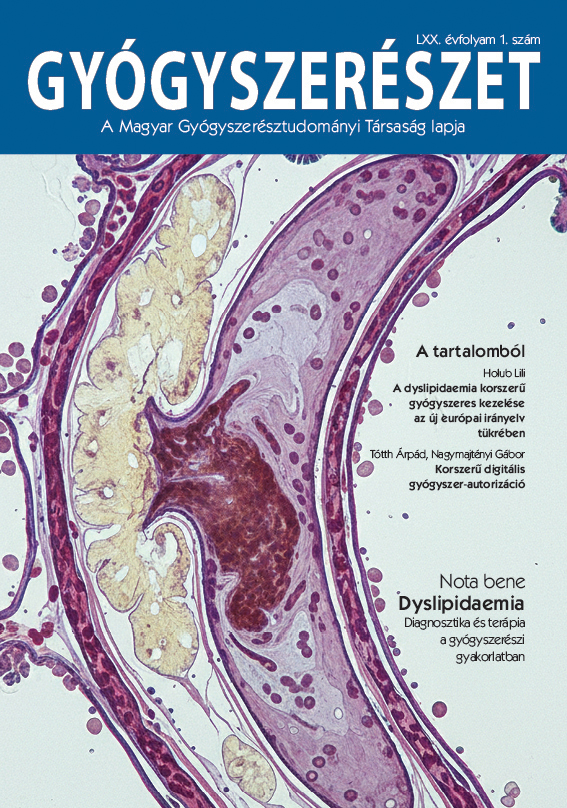
2026. január TESZT
A Gyógyszerészet 2026. januári tesztkérdései ezen a linken elérhetők.
Az MGYT távoktatásában kizárólag a Gyógyszerészet szaklap előfizetői vehetnek részt, akik 2026. március végéig regisztráltak az MGYT honlapján.
Az előfizetéssel rendelkező, regisztrált résztvevők számára az év végén 20 pontot írunk jóvá a GYOFTEX rendszerében.
Tartalom
Tisztelt MGYT-tagok, tisztelt Szakmai Közösség! Az év vége mindig lehetőség arra, hogy számba vegyük a Társaság tevékenységét és kijelöljük a következő időszak irányait. Számomra 2025 különösen meghatározó év volt, mivel május 10-én a küldöttgyűlés bizalmából átvehettem a Magyar Gyógyszerésztudományi Társaság elnöki feladatait. Megtiszteltetés és felelősség egy olyan közösség élére állni, amely a magyar gyógyszerészet minden területén értéket teremtett a történetének több mint száz éve alatt, gyakran viharos körülmények között is. Ezúton is köszönet illeti prof. Szökő Évát és a korábbi elnökség minden tagját, hogy az elmúlt ciklusokban stabil szakmai alapokra építve vezették a Társaságot. Ezekre a biztos alapokra támaszkodva folytatjuk az együttműködések erősítését, a szakterületek közötti hidak építését és a gyógyszerészet társadalmi szerepének láthatóbbá tételét.
…
Továbbképző közlemények
A dyslipidaemia a cardiovascularis betegségek egyik legjelentősebb, ugyanakkor több ponton is kedvezően módosítható kockázati tényezője. A gyógyszeres kezelés alapját továbbra is a statinok jelentik, azonban az elmúlt években több új hatásmechanizmusú készítmény vált elérhetővé. Ezek lehetővé teszik a lipidcsökkentés intenzívebbé és személyre szabottabbá tételét. Az újabb terápiák hatékony kiegészítést nyújtanak azokban az esetekben, amikor a hagyományos kezelés nem elegendő vagy nem tolerálható. A legújabb európai irányelvek a korai, kombinációs megközelítést és a cardiovascularis kockázat pontosabb becslését hangsúlyozzák, különösen a magas és nagyon magas kockázatú betegek esetében. A dyslipidaemia korszerű kezelése egyre inkább multidiszciplináris szemléletet igényel, amelyben a gyógyszeres terápia optimalizálása mellett kiemelt szerepet kap a betegedukáció és a hosszú távú adherencia biztosítása.
Kulcsszavak: dyslipidaemia, európai ajánlás, gyógyszeres kezelés, célértékre történő kezelés, LDL-koleszterin-célérték elérése
Modern pharmacotherapy of dyslipidemia in light of new European guidelines
Dyslipidaemia is one of the most significant cardiovascular risk factors, yet it is amenable to favourable modification through multiple therapeutic approaches. Statins remain the cornerstone of pharmacological treatment; however, in recent years several agents with novel mechanisms of action have become available, enabling more intensive and individualised lipid-lowering strategies. These newer therapies provide effective options in patients in whom conventional treatment is insufficient or not tolerated. The latest European guidelines emphasise early combination therapy and more accurate cardiovascular risk assessment, particularly in patients at high or very high risk. Contemporary management of dyslipidaemia increasingly requires a multidisciplinary approach, in which optimisation of pharmacotherapy is complemented by patient education and the promotion of long-term treatment adherence.
Keywords: dyslipidaemia European guideline, pharmacological treatment, treat to target, LDL-cholesterol target attainment
Irodalom
1. Mach F, Baigent C, Catapano AL, et al. 2019 ESC/EAS Guidelines for the management of dyslipidaemias. Eur Heart J. 2020;41:111–188. – 2. World Health Organization. Cardiovascular diseases (CVDs). Geneva: WHO; 2023. – 3. Zheng J, Wang J, Zhang Y et al. The Global Burden of Diseases attributed to high low-density lipoprotein cholesterol from 1990 to 2019. Front Public Health. 2022 Aug 16;10:891929. – 4. ESC/EAS Scientific Document Group 2025 Focused Update of the 2019 ESC/EAS Guidelines for the management of dyslipidaemias: Developed by the task force for the management of dyslipidaemias of the European Society of Cardiology (ESC) and the European Atherosclerosis Society (EAS) Eur Heart J 2025;46:4359-4378 – 5. Visseren FLJ, Mach F, Smulders YM, et al. 2021 ESC Guidelines on cardiovascular disease prevention. Eur Heart J. 2021;42:3227–3337. – 6. Karalis DG, Wild RA, Maki KC et al. Gender differences in side effects and attitudes regarding statin use in the Understanding Statin Use in America and Gaps in Patient Education (USAGE) study. J Clin Lipidol. 2016 Jul-Aug;10(4):833-841. – 7. Keech A, Simes RJ, Barter P, et al. Effects of long-term fenofibrate therapy on cardiovascular events in 9795 people with type 2 diabetes mellitus (the FIELD study): randomised controlled trial. Lancet. 2005;366(9500):1849–1861. – 8. Ginsberg HN, Elam MB, Lovato LC, et al. Effects of combination lipid therapy in type 2 diabetes mellitus. N Engl J Med. 2010;362(17):1563–1574. – 9. Cannon CP, Blazing MA, Giugliano RP, et al. Ezetimibe Added to Statin Therapy after Acute Coronary Syndromes. N Engl J Med. 2015;372(25):2387–2397. – 10. Katzmann JL, Gouni-Berthold I, Laufs U. PCSK9 inhibition: insights from clinical trials and future prospects. Front Physiol. 2020;11:595819. – 11. Sabatine MS, Giugliano RP, Keech AC, et al. Evolocumab and clinical outcomes. N Engl J Med. 2017;376:1713–1722. – 12. Schwartz GG, Steg PG, Szarek M, et al. Alirocumab and cardiovascular outcomes. N Engl J Med. 2018;379:2097–2107. – 13. Ray KK, Wright RS, Kallend D, et al. Two phase 3 trials of inclisiran in patients with elevated LDL cholesterol. N Engl J Med. 2020;382(16):1507–1519. – 14. Gutierrez OM, Zakai NA, Risdon M, et al. Bempedoic Acid and Cardiovascular Outcomes in Patients with Statin Intolerance — The CLEAR Outcomes Trial. N Engl J Med. 2024;390(1):1–12. – 15. Bhatt DL, Steg PG, Miller M, et al. Cardiovascular risk reduction with icosapent ethyl. N Engl J Med. 2019;380:11–22. – 16. Európai Gyógyszerügynökség. Vazkepa (icosapent ethyl) – európai nyilvános értékelő jelentés (EPAR). Amszterdam: Európai Gyógyszerügynökség; 2021. Elérhető: https://www.ema.europa.eu/en/medicines/human/EPAR/vazkepa. – 17. Európai Gyógyszerügynökség. Waylivra (volanesorsen) – európai nyilvános értékelő jelentés (EPAR). Amszterdam: Európai Gyógyszerügynökség; 2019. Elérhető: https://www.ema.europa.eu/en/medicines/human/EPAR/waylivra. – 18. Witztum JL, Gaudet D, Freedman SD, et al. Volanesorsen in familial chylomicronemia syndrome, N Engl J Med. 2019;381:531–542.
A neuroendokrin daganatok (NET-ek) családjába ritka, heterogén biológiai viselkedésű daganatok tartoznak, amelyek a diffúz endokrin rendszer sejtjeiből erednek. A neuroendokrin tumorokkal kapcsolatban általános a vélemény, hogy a ritka daganatok közé tartoznak, azonban lassú kórlefolyásuk miatt prevalenciájuk magas. A diagnózis a típusos tünetek ellenére számos esetben éveket késik. Kezelési stratégiájuk, terápiás lehetőségeik különböznek az egyéb daganatok kezelésétől. Műtéti beavatkozásra metasztatikus esetekben is gondolni kell. Az intervenciós radiológiai beavatkozásoknak kiemelt szerepük van a májmetasztázisok ellátásában. Szomatosztatinanalógok, célzott kezelések, kemoterápia és izotópkezelés metasztatikus, vagy lokálisan előrehaladott, inoperábilis esetekben jön szóba.
Kulcsszavak: neuroendokrin tumor, szomatosztatinanalóg, peptid receptor radionuklid kezelés
Treatment options for gastroenteropancreatic neuroendocrine tumors
Neuroendocrine tumors (NETs) are a family of rare tumors with heterogeneous biological behavior that originate from cells of the diffuse endocrine system. Neuroendocrine tumors are generally considered to be rare, but their prevalence is high due to their slow progression. Despite typical symptoms, diagnosis is often delayed by years. Their treatment strategies and therapeutic options differ from those of other tumors. Surgical intervention should also be considered in metastatic cases. Interventional radiological procedures play a key role in the treatment of liver metastases. Somatostatin analogues, targeted therapies, chemotherapy, and isotope therapy are considered in metastatic or locally advanced, inoperable cases.
Keywords: neuroendocrine tumor, somatostatin analog, peptide receptor radionuclide therapy
Irodalom
1. Modlin IM, Oberg K, Chung DC, et al.: Gastroenteropancreatic neuroendocrine tumours. Lancet Oncol. 2008;9 (1):61-72. – 2. Xu Z, Wang L, Dai S, et al.: Epidemiologic Trends of and Factors Associated With Overall Survival for Patients With Gastroenteropancreatic Neuroendocrine Tumors in the United States. JAMA Netw Open. 2021;4(9):e2124750. – 3. Muttillo EM, Mazzarella G, Picardi B, et al.: Treatment strategies for neuroendocrine liver metastases: a systematic review. HPB 24(11):1832-1843, 2022 – 4. Uhlyarik A, Laki A, Varga Zs, et al.: A GEP-NET tumorok kezelésével kapcsolatos gyakorlati kérdések, terápiamegválasztás szempontjai. Orvostovábbképző Szemle 25 (1. különszám):2-6, 2018 – 5. Tóth M. A gasztroenteropankreatikus neuroendokrin daganatok kezelése. Magy Onkol. 62:99-106, 2018 – 6. Borbély K, Bedros J. R, Wittmann T, et al.: A Belügyminisztérium egészségügyi szakmai irányelve a neuroendokrin tumorok nukleáris medicina diagnosztikai és terápiás ellátásáról. EGÉSZSÉGÜGYI KÖZLÖNY 72: 17 pp. 2076-2131., 56 p. 2022 – 7. Rindi, G., Mete, O., Uccella, S. et al.:: Overview of the 2022 WHO Classification of Neuroendocrine Neoplasms. Endocr Pathol 33, 115–154 (2022 – 8. Halperin DM, Shen C, Dasari A, Xu Y, Chu Y, Zhou Set al.: Frequency of carcinoid syndrome at neuroendocrine tumour diagnosis: a population-based study. Lancet Oncol 2017;18(4):525-534. – 9. Rácz K Carcinoid tumorok. Lege Artis Medicinae 2005 ;15: 11-20. – 10. Baumann T, Tottenbauer C, et al.: Gastro- enteropancreatic neuroendocrine tumours (GEP-NET) – Imaging and staging. Best Practice & Research Clinical Endocrinology & Metabolism 2016; 30:45 – 11. Binderup T, Knigge U, Loft A, Mortensen J, Pfeifer A, Federspiel B et al.: Functional imaging of neuroendocrine tumors: a head-to-head comparison of somatostatin receptor scintigraphy, 123I-MIBG scintigraphy, and 18F-FDG PET. Technol Cancer Res Treat 2007; 6:213–20. – 12. O’Toole, D, Grossman, A, Gross, D, Delle Fave G, Barkmanova J, O’Connor J, et al.: ENETS Consensus Guidelines for the Standards of Care in Neuroendocrine Tumors: Biochemical Markers. Neuroendocrinology 2009; 90: 194-202. – 13. Modlin IM, Pavel M, Kidd M, Gustafsson BI. Review article: somatostatin analogues in the treatment of gastroenteropancreatic neuroendocrine (carcinoid) tumours. Aliment Pharmacol Ther 31(2):169-188, 2010 – 14. Pavel M, Öberg K, Falconi M, et al.: Gastroenteropancreatic neuroendocrine neoplasms: ESMO Clinical Practice Guidelines for diagnosis, treatment and follow-up. Ann Oncol 31(7):844-860, 2020 – 15. Panzuto F, Ramage J, Pritchard DM, et al.: ENETS 2023 guidance paper for gastroduodenal neuroendocrine tumours (NETs) G1-G3. J Neuroendocrinol. 2023;35(8):e13306. – 16. Lamarca A, Bartsch DK, Caplin M, et al.: European Neuroendocrine Tumor Society (ENETS) 2024 guidance paper for the management of well-differentiated small intestine neuroendocrine tumours. J Neuroendocrinol. 2024; 36(9):e13423 – 17. Kaltsas G, Walter T, Knigge U, et al.: ENETS 2023 guidance: appendiceal NETs. J Neuroendocrinol.2023;35(10):e13332. – 18. Rinke A, Ambrosini V, Dromain C, Garcia-Carbonero R, Haji A, Koumarianou A, van Dijkum EN, O’Toole D, Rindi G, Scoazec JY, Ramage J. European Neuroendocrine Tumor Society (ENETS) 2023 guidance paper for colorectal neuroendocrine tumours. J Neuroendocrinol. 2023 Jun;35(6):e13309. – 19. Partelli S, Andreasi V, Rancoita PMV, et al.: Outcomes after distal pancreatectomy for neuroendocrine neoplasms: a retrospective comparison between minimally invasive and open approach using propensity score weighting. Surg Endosc. 2021;35(1):165-173. – 20. Kos-Kudła B, Castaño JP, Denecke T, et al.: European Neuroendocrine Tumour Society (ENETS) 2023 guidance paper for nonfunctioning pancreatic neuroendocrine tumours. J Neuroendocrinol. 2023; 35(12):e13343. – 21. Rinke A, Muller HH, Schade-Brittinger C, et al.: Placebo-controlled, double-blind, prospective, randomized study on the effect of octreotide LAR in the control of tumor growth in patients with metastatic neuroendocrine midgut tumors: a report from the PROMID Study Group. J Clin Oncol 27:4656-4663,2009 – 22. Caplin ME, Pavel M, Cwikla JB, et al.: Anti-tumour effects of lanreotide for pancreatic and intestinal neuroendocrine tumours: the CLARINET open-label extension study. Endocr Relat Cancer 23:191-199, 2016 – 23. Hennrich U, Kopka K. Lutathera®: The First FDA- and EMA-Approved Radiopharmaceutical for Peptide Receptor Radionuclide Therapy. Pharmaceuticals (Basel) 12(3):114, 2019 – 24. Lutathera. Alkalmazási előírás https://ec.europa.eu/health/documents/community-register/2019/20190325144329/anx_144329_hu.pdf – 25. Strosberg J, Wolin E, Chasen B, et al.: Health-related quality of life in patients with progressive midgut neuroendocrine tumors treated with (177) Lu-Dotatate in the phase III NETTER-1 trial.: J Clin Oncol 36:2578-2584, 2018 – 26. Singh S, Halperin D, Myrehaug S, et al.: [177Lu]Lu-DOTA-TATE plus long-acting octreotide versus highdose long-acting octreotide for the treatment of newly diagnosed, advanced grade 2-3, well-differentiated, gastroenteropancreatic neuroendocrine tumours (NETTER-2): an open-label, randomised, phase 3 study. Lancet 29;403(10446):2807-2817, 2024 – 27. Kos-Kudła B, Castaño JP, Denecke T, et al.:: European Neuroendocrine Tumour Society (ENETS) 2023 guidance paper for nonfunctioning pancreatic neuroendocrine tumours. J Neuroendocrinol 35(12):e13343, 2023 – 28. Yao JC, Lombard-Bohas C, Baudin E, et al.: Daily oral everolimus activity in patients with metastatic pancreatic neuroendocrine tumors after failure of cytotoxic chemotherapy: a phase II trial.: J Clin Oncol 28:69-76, 2010 – 29. Yao JC, Shah MH, Ito T, et al.: Everolimus for advanced pancreatic neuroendocrine tumors. N Engl J Med 364:514-523, 2011 – 30. Yao JC, Fazio N, Singh S, et al.: Everolimus for the treatment of advanced, non-functional neuroendocrine tumours of the lung or gastrointestinal tract (RADIANT-4): a randomised, placebo-controlled, phase 3 study. Lancet 387:968-977, 2016 – 31. Raymond E, Dahan L, Raoul JL, et al.: Sunitinib malate for the treatment of pancreatic neuroendocrine tumors. N Engl J Med 364: 501-513, 2011 – 32. Cabometyx alkalmazási előírás: https://ec.europa.eu/health/documents/community-register/2025/20250723166994/anx_166994_hu.pdf – 33. Chan JA, Geyer S, Zemla T, et al.: Phase 3 Trial of Cabozantinib to Treat Advanced Neuroendocrine Tumors. N Engl J Med. 2025;392(7):653-665. – 34. Sorbye H, Grande E, Pavel M, et al.: European Neuroendocrine Tumor Society (ENETS) 2023 guidance paper for digestive neuroendocrine carcinoma. J Neuroendocrinol. 35(3):e13249,2023
A jelen tanulmány a modern közigazgatási rendszerek egy elosztott, kriptográfiai alapú digitális autorizációs modell koncepcióját mutatja be. Célunk, hogy megmutassuk, miként lehet a betegek, az orvosok és a gyógyszerészek együttműködését egy hiteles, transzparens, mégis az érzékeny adatokat és a személyiségi jogokat is védő rendszerben megvalósítani.
Kulcsszavak: digitális gyógyszer-autorizáció, elosztott rendszerek, személyiségi jogok
State-of-the-art digital drug authorization
This study presents the concept of a distributed, cryptography-based digital authorization model for modern administrative systems, using the example of a specific but widely known process: the prescription and dispensing of medicines. Our goal is to show how cooperation between patients, doctors, and pharmacists can be achieved in an authentic, transparent system that also protects sensitive data and personal rights.
Keywords: digital drug authorization, distributed public key infrastructure, personal rights
Irodalom
1. www.idcrypt.global Business Resource: Decentralised Public Key Infrastructure (DPKIps) – ID Crypt Global Letöltés: 2025. 12. 06. –
2. komodoplatform.com What’s A Merkle Tree? A Simple Guide To Merkle Trees Letöltés: 2025. 12.06.
Aktuális oldalak
Nota bene
BrAIN
A gyermekkori epilepszia heterogén betegségcsoport, amelyet a csecsemőkorban, gyermekkorban vagy serdülőkorban jelentkező, visszatérő, kiváltó ok nélküli rohamokra való hajlam jellemez. Ez az áttekintés összefoglalja a jelenlegi ismereteket az epidemiológiáról, a patofiziológiáról, a diagnosztikai vizsgálatokról (a betegágy melletti értékeléstől a modern képalkotó diagnosztikáig és genetikáig) és a jelenlegi kezelési módszerekről – gyógyszeres, étrendi, sebészi és neuromodulációs –, különös tekintettel a modern fejlesztésekre és a precíziós terápiákra. A legfontosabb kihívások továbbra is a megfelelő időben történő etiológiai diagnózis, a gyógyszerrezisztens epilepszia kezelése, a neurológiai komorbiditás, valamint a morbiditás és mortalitás (beleértve a SUDEP-et) megelőzése. Az új stratégiák, mint például a célzott terápiák, a molekuláris diagnosztika és a multimodális, műtét előtti értékelés, jobb eredményeket ígérnek bizonyos betegek esetében.
Kulcsszavak: gyermekkori epilepszia, gyógyszeres terápia
Medical treatment of childhood epilepsy
Paediatric epilepsy comprises a heterogeneous group of disorders defined by a predisposition to recurrent unprovoked seizures arising in infancy, childhood, or adolescence. This review summarizes contemporary knowledge on epidemiology, pathophysiology, diagnostic work-up (from bedside assessment to advanced imaging and genetics), and current treatment modalities – pharmacologic, dietary, surgical and neuromodulatory – with emphasis on modern developments and precision approaches. Key challenges remain timely diagnosis, management of drug-resistant epilepsy, neurodevelopmental comorbidity, and prevention of morbidity and mortality (including SUDEP). Emerging strategies such as gene-targeted therapies, improved molecular diagnostics and multimodal presurgical evaluation promise better outcomes for selected children.
Keywords: childhood epilepsy, pharmacotherapy
Irodalom
1. Falco-Walter, J. Epilepsy-Definition, Classification, Pathophysiology, and Epidemiology. Semin Neurol 2020, 40, 617–623, doi:10.1055/s-0040-1718719. – 2. Szirmai I. Neurológia; IV. kiadás.; Medicina Könyvkiadó Zrt.: Budapest, 2017; – 3. Dr. Kóbor J. Neurológia – Gyermekkori Epilepszia: Tünettan, Etiológia, Szindrómák. Gyermekorvos Továbbképzés 2006, V.évfolyam, 37–41. – 4. Johnson, E.L. Seizures and Epilepsy. Medical Clinics of North America 2019, 103, 309–324. – 5. Pack, A.M. Epilepsy Overview and Revised Classification of Seizures and Epilepsies (; 2019; Vol. 25;. – 6. Magyar Epilepszia Liga vezetősége Az Egészségügyi Minisztérium Szakmai Irányelve; – 7. Guerrini, R. Seminar Epilepsy in Children; 2006; Vol. 367. – 8. Lado, F.A.; Ahrens, S.M.; Riker, E. Muh, C.R.; Richardson, R.M.; Gray, J.; Small, B.; Lewis, S.Z.; Schofield, T.J.; Clarke, D.F.; et al. Guidelines for Specialized Epilepsy Centers: Executive Summary of the Report of the National Association of Epilepsy Centers Guideline Panel. Neurology 2024, 102, e208087, doi:10.1212/WNL.0000000000208087. – 9. Pressler, R.M.; Abend, N.S.; Auvin, S.; Boylan, G.; Brigo, F.; Cilio, M.R.; De Vries, L.S.; Elia, M.; Espeche, A.; Hahn, C.D. et al. Treatment of Seizures in the Neonate: Guidelines and Consensus-Based Recommendations—Special Report from the ILAE Task Force on Neonatal Seizures. Epilepsia 2023, 64, 2550–2570, doi:10.1111/epi.17745. – 10. www.neurology-jp.org/guidelinem/epilepsy/Part1_chapter6 Letöltés 2025 12.22.
A polycystás ovarium szindróma (polycystic ovarian syndrome, PCOS) a nők egyik leggyakoribb endokrin rendellenessége; tünetei komplexek, melyeket bonyolult átlátni és gyógyítani. Kérdőíves kutatással, szakirodalmak segítségével célom volt felmérni olyan alternatív, nem orvosi rendelvényre felírt módszereket, melyeket a PCOS-sel érintett nők használnak; illetve áttekinteni azokat a gyógynövényeket, amelyek jótékony hatással lehetnek a PCOS és szövődményei kezelésében.
A kutatásban leghatásosabbnak bizonyult barátcserje kivonata a szakirodalom szerint többek között korrigálja az ösztrogénfüggő hormonális egyensúlyhiányt, csökkenti a PCOS tüneteit, javítja a teherbe esés esélyeit. Ezt több humán klinikai vizsgálat is alátámasztja. Az aloe vera és a kamilla javítja a termékenységet a tüszők számának növelésével; az édesgyökér, a ginzeng és a fahéj javítja a lipid- és cukorkontrollt, ami szintén előnyös PCOS esetén. Hasznos lehet az édeskömény is, mely állatkísérletekben hatékonyan mérsékelte az endometrium-hyperplasiát. Mind a szakirodalom, mind a saját kutatásom alapján több gyógynövény is ígéretes alternatíva lehet a PCOS kezelésében, ezek kombinációi pedig még célravezetőbb hatást eredményezhetnek.
Kulcsszavak: polycystás ovarium szindróma, alternatív gyógymódok, gyógynövényes terápiák
Beyond conventional treatment
Herbal therapies for PCOS
Polycystic ovary syndrome (PCOS) is one of the most common endocrine disorders in women; its symptoms are complex and difficult to treat. My goal was to assess the alternative methods used by women with PCOS through questionnaire research and literature reviews.
According to the literature, the extract of Vitex agnus-castus, which proved to be the most effective in my research, corrects estrogen-dependent hormonal imbalance, reduces PCOS symptoms, and improves the chances of getting pregnant. This is supported by several human clinical studies. Aloe vera and chamomile improve fertility by increasing the number of follicles; licorice, ginseng, and cinnamon improve lipid and sugar control, which is also beneficial in PCOS. Fennel may also be useful, as it’s been shown to effectively reduce endometrial hyperplasia in animal studies. Based on both the literature and my own research, several herbs may be promising alternatives in the treatment of PCOS, and combinations of these may eventuate better results.
Keywords: polycystic ovary syndrome, alternative therapies, herbal therapies
Irodalom
1. R. L. e. a. Shukla A., „Polycystic Ovarian syndrome,” 2025. júl. 7. – 2. E. e. a. Tóth, „A Polycystás Ovarium Szindróma (PCOS) Pszichológiai Következményei.,” 2024. pp. 176–188. – 3. A. S. e. a. Manouchehri A, „Polycystic ovaries and herbal remedies: A systematic review. JBRA Assist Reprod.,” 2023. már. 30. doi: 10.5935/1518-0557. – 4. T. C. e. a. Teede HJ, „Recommendations From the 2023 International Evidence-based Guideline for the Assessment and Management of Polycystic Ovary Syndrome. J Clin Endocrinol Metab.,” 2023. szep. 18. doi: 10.1210/clinem/dgad463. – 5. G. P., „Spearmint herbal tea has significant anti-androgen effects in,” 2010. feb. 24. doi: 10.1002/ptr.2900. PMID: 19585478. – 6. EMA. – Online.. Available: https://www.ema.europa.eu/en/medicines/herbal/agni-casti-fructus. – 7. https://ogyei.gov.hu/felulvizsgalati_kerelmek. – 8. P. M. e. a. Westphal LM, „Double-blind, placebo-controlled study of Fertilityblend: a nutritional supplement for improving fertility in women. Clin Exp Obstet Gynecol.,” 2006.; PMID: 17211965. – 9. A. R. e. a. Wang JG, „The effect of cinnamon extract on insulin resistance parameters in polycystic ovary syndrome: a pilot study. Fertil Steril.,” 2007. doi: 10.1016/j.fertnstert. – 10. H. S. e. a. Shabani T, „Comparison of the Hydro-Alcoholic Extract of Ginseng Root with Metformin in Rats with Polycystic Ovary Syndrome. Armaghan Danesh,” 2017.; 21:1087-99.. – 11. B. M. e. a. Farideh ZZ, „ Effects of chamomile extract on biochemical and clinical parameters in a rat model of polycystic ovary syndrome. J Reprod Infertil.,” 2010.; 11:169-74.. – 12. S. M. Wani R, „Healing with Herbs: A Systematic Review of Natural Treatments for Polycystic Ovary Syndrome. JBRA Assist Reprod.,” 2025. júl. 30.; doi: 10.5935/1518-0557.20240110.
Gyógyszerészet-történet
Irodalom
1. Gyógyszerészet, 43, 325-8 (1999). – 2. Gyógyszerészi Hetilap, 31, 537 (1892).