

2026. július TESZT
A Gyógyszerészet 2026. júliusi tesztkérdései ezen a linken elérhetők.
Az MGYT távoktatásában kizárólag a Gyógyszerészet szaklap előfizetői vehetnek részt, akik 2026. március végéig regisztráltak az MGYT honlapján.
Az előfizetéssel rendelkező, regisztrált résztvevők számára az év végén 20 pontot írunk jóvá a GYOFTEX rendszerében.
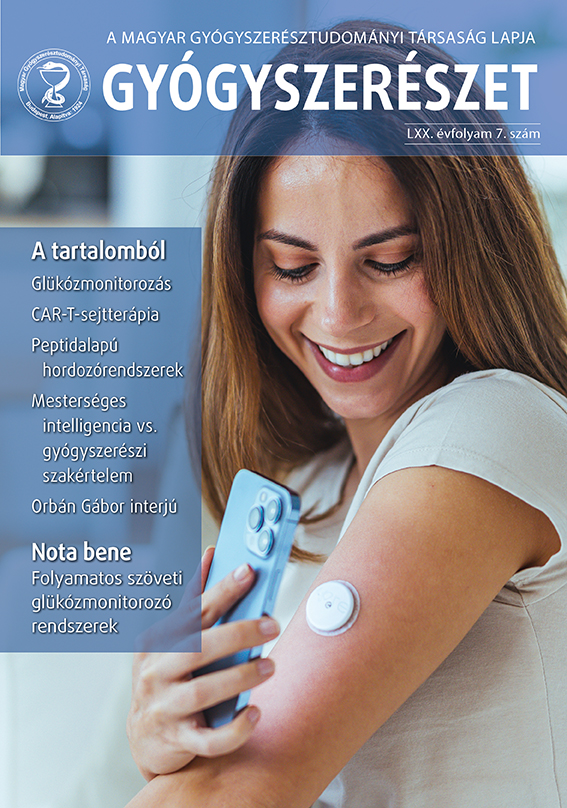
Tartalom
Továbbképző közlemények
A klinikai igény szükségessé, a technika fejlődése pedig lehetővé tette a diabeteses betegek részére a folyamatos glükózmonitorozást és a kapott értékek alapján történő inzulinadagolást. A jelen összefoglaló történeti és technikai áttekintést ad a glükózmonitorozó eszközök fejlődéséről, működési elveiről és a hozzájuk kapcsolódó inzulinadagoló rendszerek működéséről. A folyamatos glükózmonitorozó eszközök elterjedése hozta be a gyakorlatba az AGP (Ambulatory Glucose Profile) jelentést és a céltartományban töltött idő koncepcióját. A klinikai gyakorlatban óriási előrelépést jelent az automata inzulinadagoló rendszerek elterjedése. Lassan körvonalazódik a jövő, ami itt is mesterséges intelligencia és gépi tanulás alapú lesz és még közelebb kerülnek a diabeteses betegek a szövődménymentes élethez.
Kulcsszavak: folyamatos glükózmonitorozás, CGM, ambuláns glükóz profil, AGP, inzulinadagoló rendszerek
The technological evolution of glucose monitoring: From urine tests to the artificial pancreas
Clinical need has necessitated – and technological advances have made possible – continuous glucose monitoring for patients with diabetes and insulin dosing based on the measured values. This review provides a historical and technical overview of the development of glucose monitoring devices, their operating principles, and the functioning of associated insulin delivery systems. The widespread adoption of continuous glucose monitoring devices has introduced the AGP (Ambulatory Glucose Profile) report and the concept of time in target range into clinical practice. The widespread adoption of automated insulin delivery systems represents a huge step forward in clinical practice. And the future is slowly taking shape; it will be based on artificial intelligence and machine learning, bringing people with diabetes even closer to a life free of complications.
Keywords: continuous glucose monitoring, CGM, ambulatory glucose profile, AGP, insulin delivery systems
Irodalom
Tegegne, B.A., et al., A critical review on diabetes mellitus type 1 and type 2 management approaches: from lifestyle modification to current and novel targets and therapeutic agents. Front Endocrinol (Lausanne), 2024. 15: p. 1440456.
American Diabetes Association Professional Practice, C., 2. Diagnosis and Classification of Diabetes: Standards of Care in Diabetes-2024. Diabetes Care, 2024. 47(Suppl 1): p. S20-S42.
Clarke, S.F. and J.R. Foster, A history of blood glucose meters and their role in self-monitoring of diabetes mellitus. Br J Biomed Sci, 2012. 69(2): p. 83-93.
Bender, C., P. Vestergaard, and S.L. Cichosz The History, Evolution and Future of Continuous Glucose Monitoring (CGM). Diabetology, 2025. 6, 17 DOI: 10.3390/diabetology6030017.
Rock, J.A. and L.J. Gerende, Dextrostix method for determination of blood glucose levels. A statistical evaluation. JAMA, 1966. 198(3): p. 231-6.
Hirsch, I.B., Introduction: History of Glucose Monitoring, in Role of Continuous Glucose Monitoring in Diabetes Treatment. 2018: Arlington (VA). p. 1.
Tierney, M.J., et al., Clinical evaluation of the GlucoWatch® biographer: a continual, non-invasive glucose monitor for patients with diabetes. Biosensors and Bioelectronics, 2001. 16(9): p. 621-629.
Lee, I., et al., Continuous glucose monitoring systems – Current status and future perspectives of the flagship technologies in biosensor research. Biosens Bioelectron, 2021. 181: p. 113054.
Dermawan, D. and M.A. Kenichi Purbayanto, An overview of advancements in closed-loop artificial pancreas system. Heliyon, 2022. 8(11): p. e11648.
Rossetti, P., et al., Estimating plasma glucose from interstitial glucose: the issue of calibration algorithms in commercial continuous glucose monitoring devices. Sensors (Basel), 2010. 10(12): p. 10936-52.
Villena Gonzales, W., A.T. Mobashsher, and A. Abbosh, The Progress of Glucose Monitoring-A Review of Invasive to Minimally and Non-Invasive Techniques, Devices and Sensors. Sensors (Basel), 2019. 19(4).
Mittal, R., et al., Blood glucose monitoring devices for type 1 diabetes: a journey from the food and drug administration approval to market availability. Front Endocrinol (Lausanne), 2024. 15: p. 1352302.
Jamili, A. and M. Tayarani, Design of a microwave sensor for non-invasive monitoring of blood glucose level with high sensitivity using electromagnetic properties. Sci Rep, 2026. 16(1).
Lee, W., et al., Noninvasive subterahertz glucose monitoring using a communication inspired eye diagram. Sci Rep, 2025. 16(1): p. 1079.
Yuwen, T., et al., Carbon nanotubes: a powerful bridge for conductivity and flexibility in electrochemical glucose sensors. J Nanobiotechnology, 2023. 21(1): p. 320.
Lombardo, C., et al., Update on Pancreatic Transplantation in the Management of Diabetes, in Endotext, K.R. Feingold, et al., Editors. 2000: South Dartmouth (MA).
Mariani, H.S., B.T. Layden, and G. Aleppo, Continuous Glucose Monitoring: A Perspective on Its Past, Present, and Future Applications for Diabetes Management. Clin Diabetes, 2017. 35(1): p. 60-65.
Cappon, G., et al., Continuous Glucose Monitoring Sensors for Diabetes Management: A Review of Technologies and Applications. Diabetes Metab J, 2019. 43(4): p. 383-397.
Összefoglalónkban a terápiás szerek hatékony szállítását és célba juttatását szolgáló mesterségesen előállított sejtes hordozók, peptidvektorok és hibrid nanostruktúrák bemutatását tűztük ki célul. Áttekintettük a molekuláris tervezési elveket, a működési mechanizmusokat, valamint az in vitro/in vivo vizsgálatokat tárgyaló szakirodalmat, elsősorban a neuroonkológiára, az immunterápiára és a regeneratív gyógyászatra fókuszálva, különös tekintettel a felvételi útvonalakra, az endoszomális menekülési mechanizmusokra és a szerkezet-funkció kapcsolatára. Elemzésünk alapján a területen robbanásszerű fejlődés várható, számos készítmény már klinikai fázisvizsgálat alatt áll, de a léptéknövelés, a gyártás, biztonság és hatósági engedélyeztetés terén adódnak kihívások, ezért a teljes klinikai potenciáljuk eléréséhez további kémiai tervezés, molekuláris mérnöki munka és a transzlációs kutatás folyamatos integrációja szükséges. A kézirat a Pharmaceutics különszámában megjelent cikkünk alapján készült.
Kulcsszavak: sejtmediált, peptid, gyógyszeradagolás, nanotechnológia, vér-agy gát, gyógyszerészet
Cell-mediated and peptide-based delivery systems: New horizons in targeted therapy – Part 1
In this review, we aim to present artificially produced cellular carriers, peptide vectors, and hybrid nanostructures designed for the efficient delivery and targeting of therapeutic agents. We reviewed the principles of molecular design, mechanisms of action, and the literature discussing in vitro/ in vivo studies, focusing primarily on neuro-oncology, immunotherapy, and regenerative medicine, with particular attention to uptake pathways, endosomal escape mechanisms, and the structure-function relationship. Based on our analysis, explosive growth is expected in this field; numerous compounds are already undergoing clinical trials, but challenges remain in scaling up, manufacturing, safety, and regulatory approval. Therefore, further chemical design, molecular engineering, and the continuous integration of translational research are required to reach their full clinical potential. This manuscript is based on our article published in a special issue of Pharmaceutics.
Keywords: cell-mediated, peptide, drug delivery, nanotechnology, blood-brain barrier, pharmacy
Irodalom
- Gori A, Lodigiani G, Colombarolli SG, Bergamaschi G, Vitali A. Cell Penetrating Peptides: Classification, Mechanisms, Methods of Study, and Applications. ChemMedChem. 2023;18(17):e202300236.
- Milletti F. Cell-penetrating peptides: classes, origin, and current landscape. Drug Discov Today. 2012;17(15-16):850-60.
- Chatterjee S, Kon E, Sharma P, Peer D. Endosomal escape: A bottleneck for LNP-mediated therapeutics. Proc Natl Acad Sci U S A. 2024;121(11):e2307800120.
- Muttenthaler M, King GF, Adams DJ, Alewood PF. Trends in peptide drug discovery. Nat Rev Drug Discov. 2021;20(4):309-25.
- Fan D, Cao Y, Cao M, Wang Y, Cao Y, Gong T. Nanomedicine in cancer therapy. Signal Transduct Target Ther. 2023;8(1):293.
- Kanasty R, Dorkin JR, Vegas A, Anderson D. Delivery materials for siRNA therapeutics. Nat Mater. 2013;12(11):967-77.
- Khan MM, Filipczak N, Torchilin VP. Cell penetrating peptides: A versatile vector for co-delivery of drug and genes in cancer. J Control Release. 2021;330:1220-8.
- Ali Zaidi SS, Fatima F, Ali Zaidi SA, Zhou D, Deng W, Liu S. Engineering siRNA therapeutics: challenges and strategies. J Nanobiotechnology. 2023;21(1):381.
- Song Y, Lei L, Cai X, Wei H, Yu CY. Immunomodulatory Peptides for Tumor Treatment. Adv Healthc Mater. 2025;14(5):e2400512.
- Hancock RE, Sahl HG. Antimicrobial and host-defense peptides as new anti-infective therapeutic strategies. Nat Biotechnol. 2006;24(12):1551-7.
- Portincasa P, Bonfrate L, Vacca M, De Angelis M, Farella I, Lanza E, et al. Gut Microbiota and Short Chain Fatty Acids: Implications in Glucose Homeostasis. Int J Mol Sci. 2022;23(3).
- Yin LY, Li XC, Wang RR, Zeng YY, Zeng ZW, Xie T. Recent Research Progress of RGD Peptide-Modified Nanodrug Delivery Systems in Tumor Therapy. Int J Pept Res Ther. 2023;29(4).
- Javid H, Oryani MA, Rezagholinejad N, Esparham A, Tajaldini M, Karimi-Shahri M. RGD peptide in cancer targeting: Benefits, challenges, solutions, and possible integrin-RGD interactions. Cancer Med. 2024;13(2):e6800.
- Zhang C, Shang Y, Chen X, Midgley AC, Wang Z, Zhu D, et al. Supramolecular Nanofibers Containing Arginine-Glycine-Aspartate (RGD) Peptides Boost Therapeutic Efficacy of Extracellular Vesicles in Kidney Repair. ACS Nano. 2020;14(9):12133-47.
- Galindo JM, Merino S, Herrero MA. Advanced Hydrogels: Enhancing Tissue Bioengineering with RGD Peptides and Carbon Nanomaterials. ChemMedChem. 2025;20(3):e202400587.
- Ding G, Wang T, Han Z, Tian L, Cheng Q, Luo L, et al. Substance P containing peptide gene delivery vectors for specifically transfecting glioma cells mediated by a neurokinin-1 receptor. J Mater Chem B. 2021;9(32):6347-56.
- Jeyarajan S, Xavier J, Rao NM, Gopal V. Plasmid DNA delivery into MDA-MB-453 cells mediated by recombinant Her-NLS fusion protein. Int J Nanomedicine. 2010;5:725-33.
- Mardani G, Bolhassani A, Agi E, Shahbazi S, Mehdi Sadat S. Protein vaccination with HPV16 E7/Pep-1 nanoparticles elicits a protective T-helper cell-mediated immune response. IUBMB Life. 2016;68(6):459-67.
- Jabbari E. Targeted delivery with peptidomimetic conjugated self-assembled nanoparticles. Pharm Res. 2009;26(3):612-30.
- Wang és munkatársai…” Wang, P.;Wu,W.; Gao, R.; Zhu, H.;Wang, J.; Du, R.; Li, X.; Zhang, C.; Cao, S.; Xiang, R. Engineered Cell-Assisted Photoactive Nanoparticle Delivery for Image-Guided Synergistic Photodynamic/Photothermal Therapy of Cancer. ACS Appl. Mater. Interfaces 2019, 11, 13935–13944.
- Liu és munkatársia…” Liu, H.; Lei, D.; Li, J.; Xin, J.; Zhang, L.; Fu, L.;Wang, J.; Zeng,W.; Yao, C.; Zhang, Z.; et al. MMP-2 Inhibitor-Mediated Tumor Microenvironment Regulation Using a Sequentially Released Bio-Nanosystem for Enhanced Cancer Photo-Immunotherapy. ACS Appl. Mater. Interfaces 2022, 14, 41834–41850.
- Park K. Mast cells for cell-mediated therapy. J Control Release. 2015;202:118.
- Zhou J, Wang M, Wei T, Bai L, Zhao J, Wang K, et al. Endothelial Cell-Mediated Gene Delivery for In Situ Accelerated Endothelialization of a Vascular Graft. ACS Appl Mater Interfaces. 2021;13(14):16097-105.
Számos gyógyíthatatlan hematológiai eredetű daganatos megbetegedés kezelésére a betegek saját átprogramozott sejtjeit alkalmazzák. A CAR-T-terápia egy innovatív immunterápiás eljárás, mellyel jelenleg a hagyományos terápiákra nem reagáló vérképzőrendszeri eredetű malignus kórképeket kezelik. A klinikai vizsgálatok eredményei azonban túlmutatnak az onkológiai területeken. Ráadásul a protein engineering eszköztárával a legújabb kimérás antigén receptor T-sejtek túlélését, és tumorsejtölő képességét jelentősen sikerült növelni, miközben a készítmények legsúlyosabb mellékhatásait csökkentették. Az alábbiakban összefoglaljuk a CAR-T-terápia kifejlesztéséhez nélkülözhetetlen felfedezéseket, bemutatjuk a T-receptor, valamint a módosított T-receptor felépítését, a terápia lényegét és a jelenleg alkalmazott készítményeket. Kitérünk a hazai klinikai alkalmazás és finanszírozás lehetőségeire, valamint bemutatjuk a legújabb perspektívákat.
Kulcsszavak: immunterápia, CAR-T-terápia, hematoonkológia, szolid tumorok, T-lymphocyták
CAR-T-cell therapy in the treatment of cancer – Current challenges and future directions
Patients’ own reprogrammed cells are used to treat many incurable hematological malignancies. CAR-T-therapy is an innovative immunotherapy used to treat hematologic malignancies that do not respond to traditional therapies. However, the results of clinical trials extend beyond oncology. In addition, with the tools of protein engineering, the survival and tumor-killing ability of the latest chimeric antigen receptor T cells have been significantly increased, while the most serious side effects of the preparations have been reduced. Below, we summarize the discoveries essential for the development of CAR-T-therapy, present the structure of the T-receptor and the modified T-receptor, the basis of the therapy, and the currently used preparations. We discuss the possibilities of domestic clinical application and financing, and present the latest perspectives.
Keywords: immunotherapy, CAR-T-therapy, hemato-oncology, solid tumors, T lymphocytes
Irodalom
- Zugasti, I. et al. CAR-T-cell therapy for cancer: current challenges and future directions. Signal Transduct Target Ther. 10(1), 210 (2025).
- Stock, S. et al. Optimizing Manufacturing Protocols of Chimeric Antigen Receptor T Cells for Improved Anticancer Immunotherapy. Int J Mol Sci. 20(24), 6223 (2019).
- Ku, K. S. et al. Current Advancements in Anti-Cancer Chimeric Antigen Receptor T Cell Immunotherapy and How Nanotechnology May Change the Game. Int J Mol Sci. 25(10), 5361 (2024).
- Srour, S. A., & Akin, S. Chimeric Antigen Receptor T-Cell Therapy for Solid Tumors: The Past and the Future. J Immunother Precis Oncol. 6(1), 19-30 (2022).
- Mitra, A. et al. From bench to bedside: the history and progress of CAR T cell therapy. Front Immunol. 14, 1188049 (2023)
- Zhang, C. et al. Engineering CAR-T-cells. Biomark Res. 5, 22 (2017).
- Honikel, M. M. & Olejniczak, S. H. Co-Stimulatory Receptor Signaling in CAR-T-Cells. Biomol. 12(9), 1303 (2022).
- Cook, M. S. et al. CAR-T-cells containing CD28 versus 4-1BB co-stimulatory domains show distinct metabolic profiles in patients. Cell Rep. 44(7), 115973 (2025).
- Cappell, K. M., & Kochenderfer, J. N. A comparison of chimeric antigen receptors containing CD28 versus 4-1BB costimulatory domains. Nat Rev Clin Oncol. 18(11), 715-727 (2021).
- Mezősi-Csaplár, M., Szöőr, Á., & Vereb, G. CD28 and 41BB Costimulatory Domains Alone or in Combination Differentially Influence Cell Surface Dynamics and Organization of Chimeric Antigen Receptors and Early Activation of CAR T Cells. Cancers (Basel). 15(12), 3081 (2023).
- Tomasik, J., Jasiński, M., & Basak, G.W. Next generations of CAR-T-cells new therapeutic opportunities in hematology? Front Immunol. 13, 1034707 (2022).
- Golmohammadi, M., Noorbakhsh, N., & Kavianpour M. CAR-T-Cell Therapy: Managing Side Effects and Overcoming Challenges. Adv Biomed Res. 14, 38 (2025).
- Tang, X. Y. et al. Third-generation CD28/4-1BB chimeric antigen receptor T cells for chemotherapy relapsed or refractory acute lymphoblastic leukaemia: a non-randomised, open-label phase I trial protocol. BMJ Open. 6(12), e013904 (2016).
- Kim, J. et al. Trogocytosis-mediated immune evasion in the tumor microenvironment. Exp Mol Med. 57, 1–12 (2025).
- Chmielewski, M., & Abken H. TRUCKS, the fourth-generation CAR T cells: Current developments and clinical translation. Adv Cell Gene Ther. 3, e84 (2020)
- Rojas-Quintero, J. et al. Car T Cells in Solid Tumors: Overcoming Obstacles. Int J Mol Sci. 25(8), 4170 (2024).
- Tang, L. et al. Arming CAR-T-cells with cytokines and more: Innovations in the fourth-generation CAR-T-development. Mol Ther. 31(11), 3146-3162 (2023).
- Kagoya, Y. et al. A novel chimeric antigen receptor containing a JAK-STAT signaling domain mediates superior antitumor effects. Nat Med. 24(3), 352-359 (2018).
- Baker, D.J. et al. CAR T therapy beyond cancer: the evolution of a living drug. Nature. 619(7971), 707-715 (2023).
- Field, A. C. et al. Comparison of lentiviral and sleeping beauty mediated αβ T cell receptor gene transfer. PLoS One. 8(6), e68201 (2013).
- Neelapu, S. S. et al. (2017). Axicabtagene Ciloleucel CAR T-Cell Therapy in Refractory Large B-Cell Lymphoma. New England Journal of Medicine, 377(26), 2531-2544.
- Maude, S. L., et al. Tisagenlecleucel in Children and Young Adults with B-Cell Lymphoblastic Leukemia. New England J Med. 378(5), 439-448 (2018).
- Munshi, N. C., et al. Idecabtagene Vicleucel in Relapsed and Refractory Multiple Myeloma. New England J Med. 384(8), 705-716 (2021).
- Shah, K. et al. T cell receptor (TCR) signaling in health and disease. Sig Transduct Target Ther. 6, 412 (2021).
- Bal, S. et al. Arlocabtagene autoleucel-a GPRC5D-targeted CAR T-cell therapy in heavily pretreated relapsed/refractory multiple myeloma. Blood. Epub ahead of print (2026).
- Jodi, L. et al. KITE-753: An Autologous Rapid Manufactured Anti-CD19/CD20 CAR-T-Product for the Treatment of B-Cell Malignancies. Blood. 144 (Supplement 1), 3481 (2024).
- Larson, S. et al. Rondecabtagene autoleucel, an autologous, dual-targeting CD19/CD20 CAR T-cell candidate manufactured from CD62L+ enriched T cells, achieves durable responses in patients with large B-cell lymphoma. Blood. 146 (Supplement 1), 668-669 (2025).
- Shambavi, R. et al. Safety and efficacy of AZD0120, a BCMA/CD19 dual-targeting CAR T-cell therapy, in relapsed/refractory multiple myeloma: Preliminary Results from the DURGA-1 Phase 1b/2 study. Blood. 146 (Supplement 1), 269-270 (2025).
BrAIN pályázat
A mesterséges intelligencia (MI) egyre nagyobb szerepet kap a mindennapokban és a technológiában. Munkám célja az MI elméleti hátterének összefoglalása, alkalmazási lehetőségeinek bemutatása a patikákban, valamint a saját kutatási eredmény ismertetése. Felmerül a kérdés, hogy az MI képes lehet-e kiegészíteni vagy helyettesíteni a gyógyszerészek munkáját az online tanácsadásban. Bár a chatbotok (beszélgető robotok) gyors információt adnak, szakmai megalapozottságuk gyakran kérdéses. A jól betanított chatbotok gyors válaszokat nyújthatnak, segíthetnek a gyógyszerismereti információkhoz való hozzáférésben, és a patikai készletadatokkal integrálva személyre szabott ajánlásokat adhatnak. Saját projektünk, a Patika AI, RAG-technológián (Retrieval-Augmented Generation-Lekérdezés Alapú Generálás) alapuló chatbot, amely a gyógyszerészeti tudásbázist a készletadatokkal kombinálja. Eredményeink szerint a gyors reagálás előnyös, de a megbízható válaszokhoz validált szakmai adat szükséges. Az MI nem helyettesíti a személyes tanácsadást, de értékes kiegészítő lehet.
Kulcsszavak: MI, chatbot, gyógyszerészi tanácsadás, szakmai validálás
Can artificial intelligence replace the expertise of a pharmacist?
Artificial intelligence (AI) is playing an increasingly important role in everyday life and technology. The aim of this work is to summarize the theoretical background of AI, present its potential applications in pharmacies, and report our own research findings. This raises the question of whether AI could complement or even replace pharmacists in online consultations. While chatbots can provide quick information, their professional reliability is often uncertain. Well-trained chatbots can deliver fast responses, facilitate access to pharmaceutical knowledge, and, when integrated with pharmacy inventory data, offer personalized recommendations.
Our project, Patika AI, is a chatbot based on Retrieval-Augmented Generation (RAG) technology that combines a pharmaceutical knowledge base with inventory data. Our results indicate that rapid response is advantageous, but reliable answers require validated professional data. AI does not replace personal consultation but can serve as a valuable complement.
Keywords: AI, chatbot, pharmaceutical counseling, professional validation
Irodalom
- Artificial Intelligence: A Modern Approach (Stuart J. Russell & Peter Norvig)
- Artificial Intelligence (Patrick Henry Winston)
- https://elitmed.hu/ilam/pharmapraxis/a-chatgpt- a-gyogyszertari-gyakorlatban
- https://www.pannondoktor.hu/2024/11/mar-a-magyarok-90-szazaleka-tajekozodik-egeszsegugyi-panaszarol-az-internetrol/
- https://weborvos.hu/lapszemle/dr-google-egyre-tobb-magyar-beteget-fogad-287595
- https://pubmed.ncbi.nlm.nih.gov/39326035/
- https://pubmed.ncbi.nlm.nih.gov/40013072/
- https://www.sciencedirect.com/science/article/pii/S2667276625001295
Chatbot
https://patika-aichatbot.hu/, https://chatgpt.com/
Nota bene
Beszélgetősarok
Irodalom
1. Gyógyszerészi Hetilap, 16, 407-10 (1877).
Aktuális oldalak
“FAKE”-telen tudomány
Irodalom
- Sacco MA, Gualtieri S, Spiliopoulou C, Sakelliadis EI, Verrina MC, Aquila I. Kambo Administration and Its Association With Sudden Death: Clinical and Forensic Perspectives From a Systematic Review. Cureus. 2025 Jan 18;17(1):e77646. doi: 10.7759/cureus.77646.
- Sacco MA, Zibetti A, Bonetta CF, Scalise C, Abenavoli L, Guarna F, Gratteri S, Ricci P, Aquila I. Kambo: Natural drug or potential toxic agent? A literature review of acute poisoning cases. Toxicol Rep. 2022 Apr 15;9:905-913. doi: 10.1016/j.toxrep.2022.04.005.
- Sacco MA, Gualtieri S, Spiliopoulou C, Sakelliadis EI, Verrina MC, Aquila I. Kambo Administration and Its Association With Sudden Death: Clinical and Forensic Perspectives From a Systematic Review. Cureus. 2025 Jan 18;17(1):e77646. doi: 10.7759/cureus.77646.